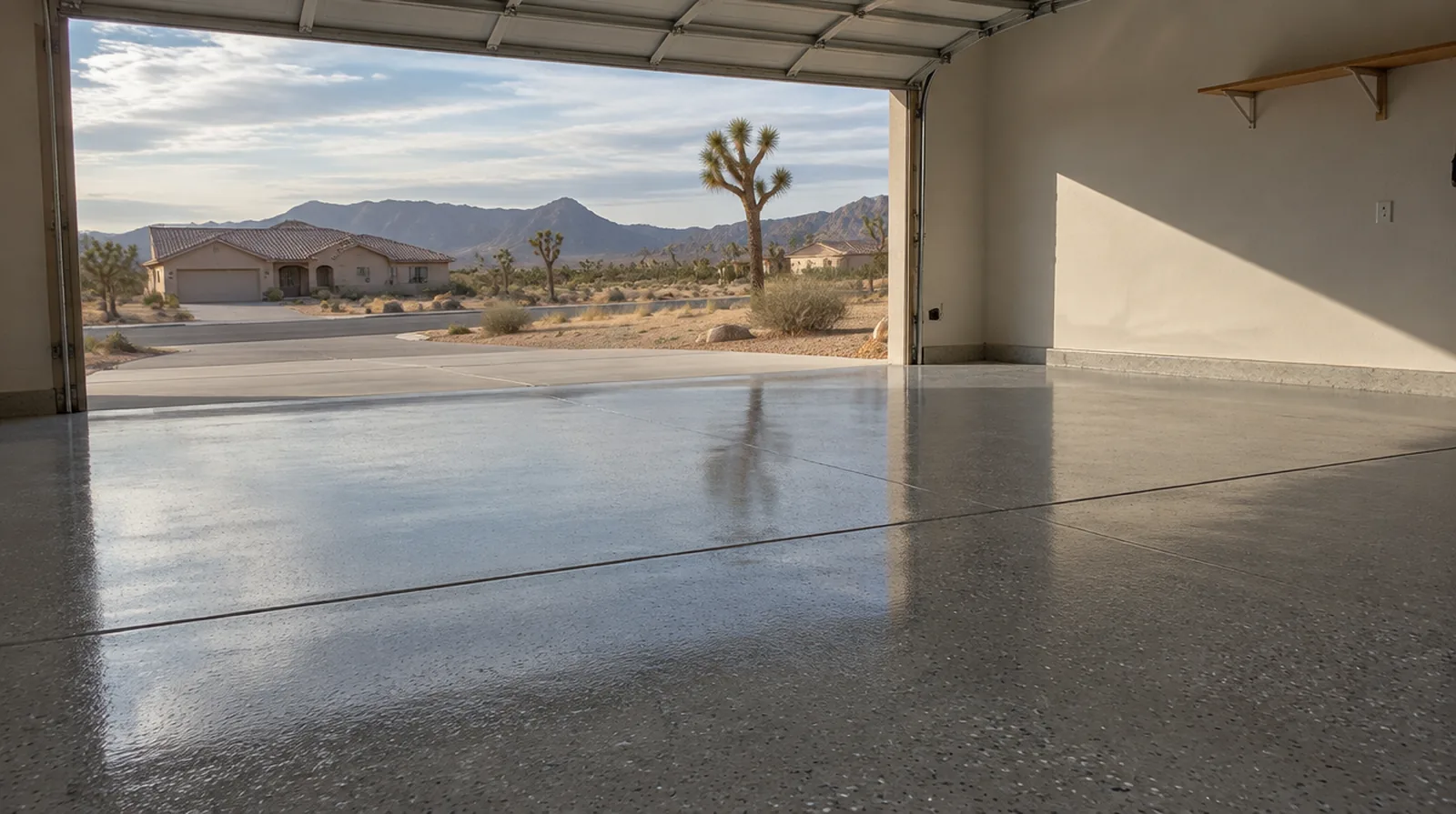
Step 1: Inspect
We check for cracks, spalling, old paint, sealers and moisture. Desert slabs often look dry but can still have moisture below.
Step 2: Grind
Diamond grinders remove laitance, sealers and contaminants, leaving a profile the primer can grab.
Step 3: Repair
Cracks are cut open and filled. Spalls and pits are patched. Joints are cleaned and filled where needed.
Step 4: Prime and coat
A penetrating primer soaks into the opened surface. A pigmented body coat follows, with chips if you want them.
Step 5: Topcoat
A UV-stable clear coat protects against sun through the garage door and abrasion from sand.
Step 6: Cure
Walk on it the next day. Park after about a week; longer in cold weather.
Why not just acid etch?
Etching does not remove sealers and leaves a weaker profile than grinding.
Will sand scratch the floor?
The topcoat resists it; sweeping often helps.
Garage floor epoxy for high desert homes
Garage floor epoxy in Hesperia has to handle heavy trucks, trailers, sand and temperature swings. Our six-step process above is built for that. Grinding gives a much stronger bond than acid etching, especially on slabs that have years of sand and oil in them, and a UV-stable top keeps the finish from yellowing near the door.
Garage questions
Can I park a loaded work truck on it? Yes, after cure. We build thicker systems for heavier vehicles.
Do you coat detached garages and shops? Yes, as long as we have power and access.
Will snowmelt hurt it? No, though we suggest rinsing off road salt from the Cajon Pass.
How long before I can use it? Foot traffic in a day, vehicles in a few days.
Why we skip acid etching
Some installers etch concrete with acid instead of grinding. Etching leaves residue, does not remove old sealers or oil, and gives an uneven profile. Grinding removes contaminants and opens the surface evenly, which is why our floors bond so well, even on older slabs that have soaked up years of sand and engine fluids.
Trailers, ATVs and toys
Many garages here hold side-by-sides, dirt bikes and trailers. Put a pad under jack stands and kickstands to spread the load, and the floor will handle years of weekend trips out to the open desert.
Work trucks, sand and the garage door seal
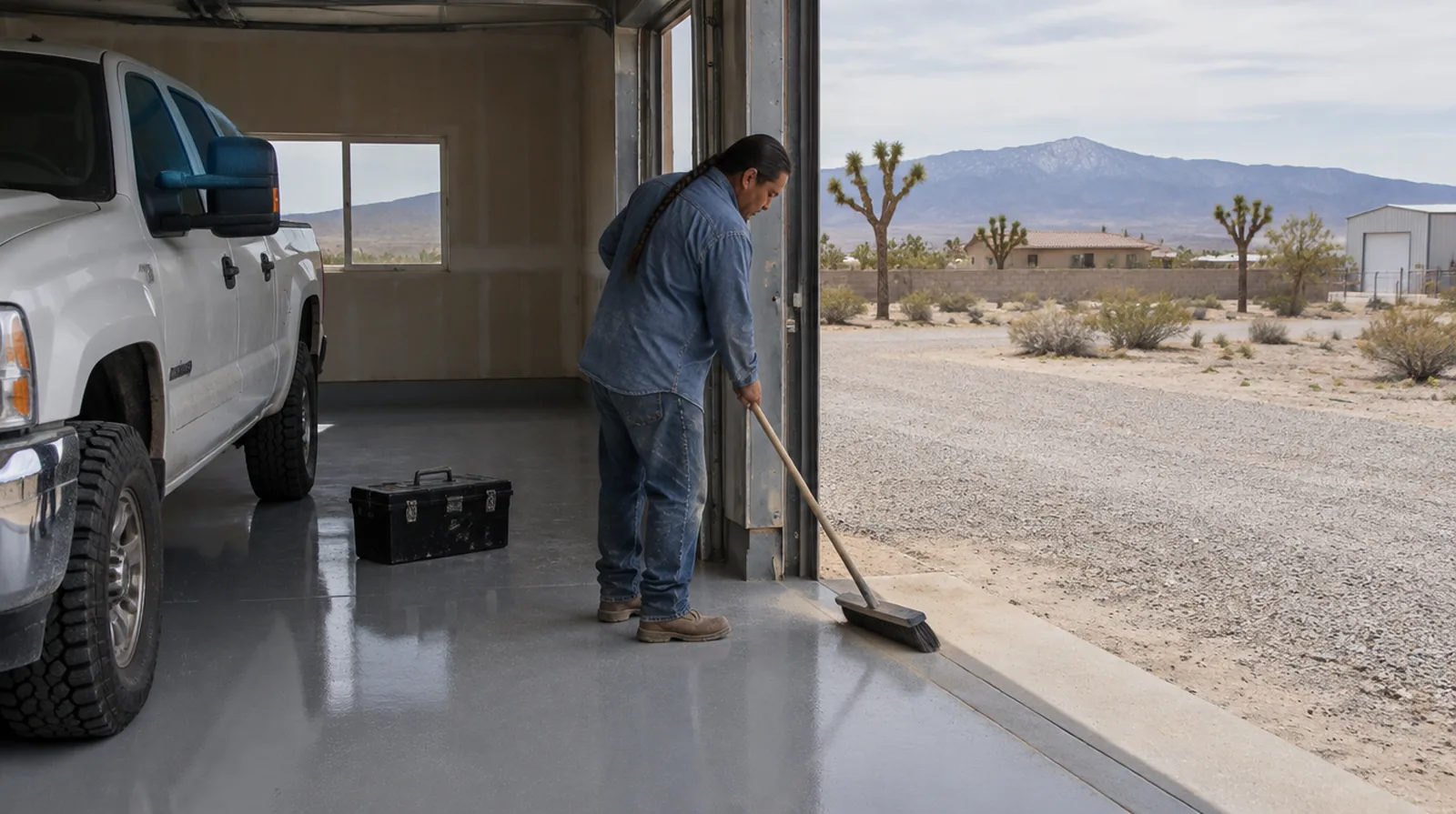
A lot of Hesperia garages see a full-size work truck every evening, sometimes with a toolbox, ladder rack and whatever dirt the job site left on the tires. Those trucks are heavier than a sedan, their tires are wider and hotter after a run up the Cajon Pass, and they bring in sand on every trip. A garage floor here has to handle that weight and that grit without lifting or turning dull in the tire paths.
We build a garage system for trucks a little heavier than a typical home job. After grinding and crack repair, we lay a penetrating primer, a thicker body coat and a clear topcoat rated for hot tire pickup. Many owners add flake, which hides the sand that always seems to be on the floor between sweeps.
The door gap matters
Wind pushes sand under a worn garage door seal and piles it along the threshold. That grit acts like sandpaper on any floor. While we coat, we look at the door seal and threshold and point out gaps worth fixing. Replacing a worn bottom seal is cheap and keeps the new floor cleaner.
Parking timeline
Foot traffic is usually fine within a day. Heavy vehicles need longer, and cold weather slows curing further. We give you a specific day to park based on the products used and the temperatures we see during install.
Living with the floor
Sweep or blow out sand regularly, rinse occasionally, and use a mat under tires that carry mud. Clean spills of brake fluid or gasoline quickly.
Can you coat a garage with a slab that slopes to the door? Yes. The slope stays; the coating follows it.
What about a garage with a floor drain? We coat around the drain and make sure water still flows to it.
Book your garage quote
Call (760) 488-6520.